
Key takeaways
- A Webflow retainer sells you one of three different things: a block of hours, a slice of capacity, or a fixed scope of work. Which one you are buying matters more than the monthly number.
- When we checked the five Webflow agencies we track on 7 September 2026, one published retainer prices, one published an ongoing plan without a number, and for three we found no published pricing for ongoing work at all.
- The clauses that decide whether a retainer is worth it are rollover, expiry, turnaround and whether your developer is shared — not the headline rate.
A Webflow retainer is a monthly agreement that buys you ongoing design and development work on an existing site: new landing pages, CMS and content updates, integrations, technical SEO fixes, performance work, and someone on the hook when something breaks. What it does not usually include is a full redesign, a new brand, or work on platforms outside Webflow.
That is the short answer, and it is where most articles on this topic stop. The more useful question is what unit you are actually buying, because agencies sell three different things under the same word, and the contract clauses around that unit decide whether the retainer is good value or a monthly invoice for work you never get around to requesting.
The three things a retainer can actually sell you
Every Webflow retainer we have seen resolves to one of three units. The monthly price is meaningless until you know which one is on the table.
A block of hours
You buy a number of hours per month and spend them on whatever you like. This is the most common model and the easiest to reason about. The risks are on the edges: what happens to hours you do not use, and what happens when you go over.
A slice of capacity
You buy a share of a team rather than a countable quantity — often described as active requests, a queue you can add to, or simply month-to-month capacity. There is no hour count to argue about, which is either refreshingly simple or completely opaque depending on how the queue is managed.
A fixed scope
You buy a defined list of things that happen every month: uptime monitoring, a set number of page builds, CMS support, a quarterly performance audit. Nothing is metered; the list either happens or it does not. This is what most agencies mean by a maintenance or care plan.
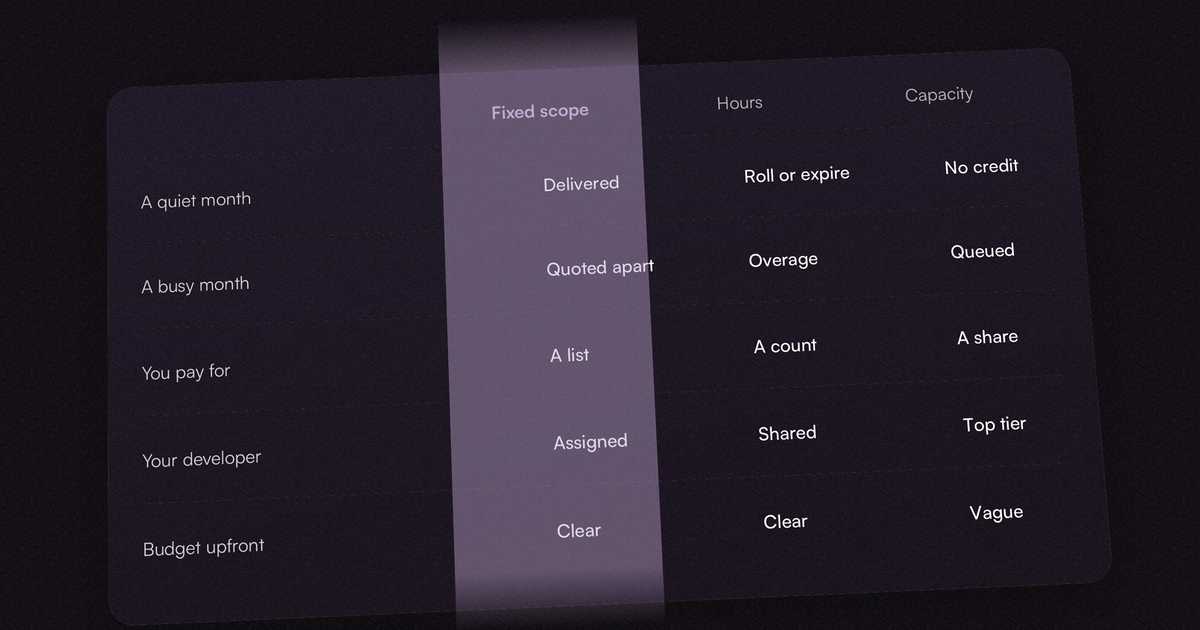
None of these is better in the abstract. Hours suit lumpy, unpredictable needs. Capacity suits teams that ship continuously and hate accounting. Fixed scope suits teams who mostly want the site to keep working. The failure mode is buying one while believing you bought another.
What Webflow agencies actually publish about retainers
We track five Webflow agencies that rank for the terms our buyers search. On 7 September 2026 we opened each one's pricing and packages pages and recorded what was published. This is a snapshot of what a buyer can find without booking a call — not a claim about what each agency offers privately.
The result: of the five, one publishes retainer prices, one publishes an ongoing plan with no number attached, and for three we found no published pricing for ongoing work. Amply is the outlier that puts numbers on the page. Effiqs names an ongoing plan but prices it by capacity. Digidop publishes project bands only. Digi Hotshot's pricing URL resolves but lists no plans. For Finsweet we found no pricing, plans or packages page.
We include ourselves in the table. Publishing a number is a positioning choice, not proof of better service — but it does let you budget before you talk to anyone. The wider argument about which pricing models agencies use, and why so many hide the number, is in Webflow agency pricing in 2026.
| Agency | Ongoing plan published | Monthly price published | What we found |
|---|---|---|---|
| Flow Hive Digitalthat's us | Yes | Yes | Care Basic, Pro and Elite on /pricing |
| Amply | Yes | Yes | Three retainer tiers from $3,000/mo |
| Effiqs | Yes | No | Growth Operations, month-to-month, capacity-priced |
| Digidop | No | No | Project bands only, $5K-$15K and $15K-$50K |
| Digi Hotshot | No | No | Pricing URL resolves, no plans listed |
| Finsweet | No | No | No pricing, plans or packages page found |
What is almost always included
Across every published plan we read, the same core keeps appearing. Treat this as the floor — if something here is missing from a proposal, ask why.
- Webflow build work. New sections, new landing pages, changes to existing ones.
- CMS work. Collection changes, new fields, bulk updates, help publishing content.
- Bug fixes and breakage. A broken mobile layout, a form that stops delivering.
- Small design work. Enough to make the new page look like the rest of the site.
- Technical SEO and performance upkeep. Metadata, schema, redirects, image weight, Core Web Vitals drift.
- A named channel and a response time. A Slack channel or shared inbox, and a commitment about how fast you hear back.
Note what that list is: maintenance plus incremental growth. A retainer keeps a good site good and gradually makes it better. Buying one hoping it will quietly turn into a rebuild is the most common way these arrangements sour.
What is almost never included
These items get quoted separately almost everywhere. None are unreasonable exclusions — they are just bigger than a monthly cadence.
- A full redesign or replatform. Scoped as a project; cost drivers are in how much a Webflow agency costs.
- Brand identity work. Logo, visual system, messaging.
- Custom application development. Anything beyond Webflow and its integrations — a real backend, an authenticated product area.
- Content production. Writing the articles, not just publishing them. Sometimes an add-on.
- Paid media and campaign management. A different discipline with different people.
- Third-party costs. Webflow's own hosting plan, fonts, stock, plugin subscriptions.
The grey zone is migrations. A single legacy page moved into Webflow is usually retainer work; three hundred blog posts moved off WordPress is a project, and we treat it as one — see migrating from WordPress without losing SEO for why the SEO side alone justifies scoping it properly.
The five clauses that decide whether it is a good deal
Two retainers at the same monthly price can differ enormously, and the difference lives in clauses buyers skim past. These are the five worth reading closely.
1. Rollover and expiry
If you buy hours, what happens to the ones you do not use? Policies range from no rollover, to a capped percentage carried one month forward, to full rollover with an expiry date. No rollover is not automatically bad — it prices reserved availability rather than consumption — but know which you are paying for, because in a quiet month one of them charges you for nothing.
2. Overage
The mirror image. When you exceed the allowance, is the extra billed at the same effective rate, at a premium hourly rate, or queued into next month? A cheap retainer with expensive overage is an expensive retainer for anyone whose demand is spiky.
3. Turnaround commitments
"We'll get to it" is not a commitment. Look for a stated response time and a stated turnaround, ideally split by task size. Amply's published plans are a useful reference point here: the top tier's stated differentiators include live response times and same-day turnaround on many tasks, which is a concrete promise rather than a vague one.
4. Dedicated or shared
This is the single biggest driver of price at the top end, and it is usually the honest explanation for a large gap between tiers. Amply's most expensive tier explicitly describes a dedicated designer or Webflow developer "not shared across accounts" — that is what the step up in price buys. A shared pool is cheaper and perfectly workable; it just means your urgent Tuesday competes with someone else's urgent Tuesday.
5. Who owns the backlog
Underused retainers fail for an unglamorous reason: nobody on the client side had time to think of requests. Ask whether the agency proposes work proactively or waits to be asked. One that brings a prioritised list to a monthly call gets used; one that depends on you remembering to file tickets quietly wastes money for a quarter and then gets cancelled.
How to tell which unit you are being sold
Four questions usually settle it, and the answers are more revealing than the proposal.
- "If we request nothing next month, what do we get?" A fixed-scope plan has a real answer. An hours plan will say the hours roll over or expire. A capacity plan may struggle, which tells you it is priced on you actually using it.
- "If we request twice as much as usual, what happens?" Listen for whether the constraint is hours, queue position, or a hard scope boundary.
- "Who does the work, and are they on other accounts?" The answer explains the price.
- "What was the last thing you told a retainer client not to spend their budget on?" An agency that has never talked a client out of anything is describing an order-taking relationship.
Still choosing between vendors? There is a longer list in 12 questions to ask a Webflow agency, and the agency-versus-freelancer-versus-in-house trade-off has its own piece.
What ours includes
For transparency, since we spent this article arguing agencies should publish this: we run fixed-scope monthly plans called Care, published on our pricing page at $1,500, $3,000 and $5,000 per month. They cover ongoing Webflow design and development, CMS work, fixes, and SEO and performance upkeep on a site we or someone else built. Full rebuilds are quoted as projects, typically three to four weeks for a B2B SaaS marketing site.
We are a Webflow agency, so read the framing above with that in mind. We publish the numbers not because it makes us cheapest — often it will not — but because a buyer who cannot budget before a sales call is a buyer who wastes a call.
| Your situation | Our pick | Why |
|---|---|---|
| Your needs are lumpy and hard to predict | Hours | You can bank a quiet month and spend it on a busy one — but only if rollover is generous |
| You ship continuously and hate timesheets | Capacity | A managed queue costs less overhead than metering, provided turnaround is committed in writing |
| You mostly need the site to keep working | Fixed scope | You pay for defined outcomes, not consumption, so an unused month is not wasted money |
| You are actually planning a rebuild | Neither | Scope it as a project and start a retainer after launch, when there is something to maintain |
FAQ
How much does a Webflow retainer cost?
Published monthly prices we could verify on 7 September 2026 start at $1,500 for our own entry Care plan and $3,000 for the lowest tier at Amply, the one other agency in our tracked set publishing retainer prices. Most of that set publishes no monthly number, so a range built from public pages is thin evidence. Treat quotes below roughly $1,000 per month with care: that is not much senior Webflow time once account overhead is covered.
Is a Webflow retainer worth it for a small site?
Often not. If your site is stable, rarely changes, and someone in-house can edit the CMS, you may be better served paying for occasional work as it comes up. Retainers earn their keep when you ship regularly — landing pages, campaign pages, continuous testing — or when downtime costs you pipeline. The honest test is whether you can name three things you would ask for next month.
Do unused retainer hours roll over?
It depends entirely on the contract, and this is the clause to read first. Common arrangements are no rollover, a capped percentage carried one month forward, or full rollover with an expiry date. No rollover is defensible when you are paying for reserved availability rather than consumption — but you should know which one you signed, because they behave very differently in a quiet quarter.
Can a retainer include a full website redesign?
Almost never, and you should be sceptical of one that claims to. A redesign is a scoped project with a discovery phase, a design phase and a launch. Trying to run it through a monthly allowance means it stretches across many months while your ordinary maintenance needs compete with it. The usual sequence is project first, retainer afterwards.
What is the difference between a retainer and a maintenance plan?
In practice the words are used loosely, but the useful distinction is ambition. A maintenance plan keeps the existing site healthy — updates, fixes, uptime, security and performance. A retainer usually includes maintenance and adds capacity for new work: pages, experiments, integrations. If a proposal is labelled a retainer but the scope is purely defensive, you are buying maintenance at a retainer price.